 Print
Print Email
EmailBarrens to Blueberries
One of the most damaged areas on the planet has been repaired, in part, by a lowly bush.
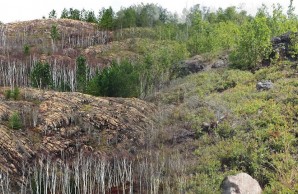
Composite photograph of birch and conifers on a typical hillside with exposed rock in the birch transition zone in the early spring (left) compared with (right) birch and lowbush blueberry, creeping up the blackened rock, in July.
Sudbury, Ontario and its surrounds have been hard-hit in the past 1.8 billion years. New evidence suggests that the first blow was by a comet—not an asteroid, as previously thought—that created the second-largest impact crater in the world, known as the Sudbury Basin. For 700,000 years, the region experienced periods of dramatic climate change, which included a series of ice ages, each lasting about 100,000 years. The last was the Wisconsin Glaciation. The Sudbury Basin was left with huge deposits of nickel, copper, and other metals from the comet and with thousands of lakes from the glaciers. Approximately 12 percent of the 3,637 square-kilometer area of the City of Greater Sudbury alone is occupied by 330 lakes.
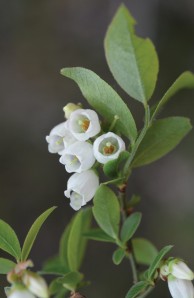
Bell-shaped flowers of lowbush blueberry
Based on studies of organisms preserved in the sediment of lakes in the area, it appears human impact on the Sudbury Basin was benign until the late nineteenth century. In 1883, however, the copper and nickel deposits— that had remained buried for 1.8 billion years—were discovered when the Canadian Pacific Railroad was blasting rock cuts to build a railway across Canada to British Columbia. The railroad also opened the area to logging of white and red pine, much of which was used to rebuild Chicago after the fire of 1871. The intense logging and aggressive mining that followed transformed the landscape and profoundly changed the chemical and biological composition of the area’s glacial lakes. Logging and mining had the biggest impact, but smaller industries, such as sawmills and creosote plants, contributed to the problem.
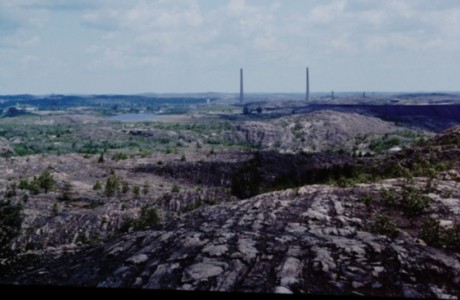
Industrial barrens near the Coniston smelter east of the city of Greater Sudbury; one of the three smelters, once operating in the region, was closed in 1972.
Thick mats of lowbush blueberries, with their intertwined stems, accumulate birch leaves in the fall, which helps protect the ground from drying out and over-heating. The first birch seedlings have a precarious existence because the habitat with its sparse vegetation tends to frost heave in late fall, which often pushes the seedlings out of the ground and breaks them apart. If they survive frost heaving, birch must tolerate abnormally high temperatures on the black rock surface, which sometimes reaches the lethal temperature of 60ºC. But once a few birches survive and start producing leaves and leaf litter, blueberry seedlings can establish and, over time, grow in thick mats. A thick leaf litter helps to retain moisture from snow and rains in following years to the benefit of both species.
Map of Sudbury Basin includes the impact zone of a probable comet, a ring of copper and nickel mines around the crater, and the city of Greater Sudbury (lower right).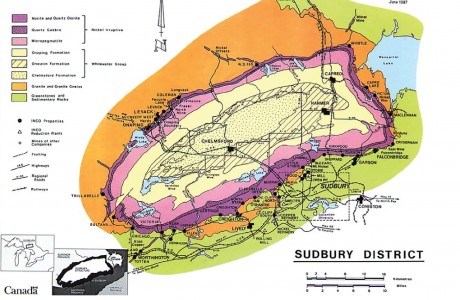
Research at Laurentian University has shown that metals do not accumulate within the fruit of blueberry plants even though leaves, stems, and roots of the Sudbury shrubs may have elevated levels. For ecologists, the recovery of this polluted environment provided the opportunity to observe a unique, human-influenced form of primary succession. Monitoring the lowbush blueberry in Sudbury’s human-altered environment has also provided me an opportunity to study their life history strategies.
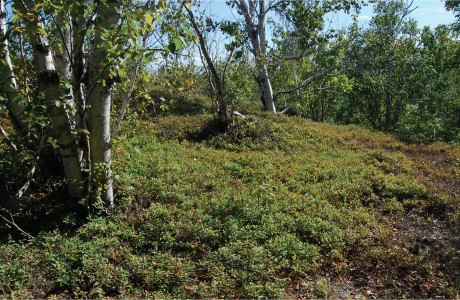
Thick carpet of lowbush blueberry growing beneath coppiced white birch.
Vaccinium angustifolium is one of three species found in eastern North America that is harvested for food. A less common species found in the Sudbury area is Vaccinium myrtiloides, which is distinguished by fuzzy leaves and stems compared to the smooth surface of V. angustifolium. A third species, the northern highbush blueberry, Vaccinium corymbosum, found in southern Ontario, is 1-3 meters tall and has been transplanted to farms elsewhere in North and Central America, where it is grown in orchards similar to apple trees. Berries from highbush are usually the ones found in grocery stores.
Lowbush blueberries have been a food staple in eastern North America for centuries, with indigenous peoples and settlers maintaining small patches by burning the patches every three to four years. Today, larger fields are maintained in much the same way by commercial growers. The fruit is harvested on a two– or three-year rotation, following either mowing or burning of the shrubs to stimulate the formation of adventitious shoots and a dense blueberry crop. Because lowbush blueberries can’t be planted or farmed the way other industrial crops can, they are the only ones marketed as “wild” blueberries. They are known for their nutritious value because of their high level of antioxidants.
I have been observing lowbush blueberry shrubs near the center of the birch transition zone since 1975. I have watched shrubs colonize barren sites, bounce back from complete defoliation by gypsy moths and forest tent caterpillars, and survive severe drought. In 2015, however, all plants suddenly dropped their immature berries in early July. In attempting to determine what went wrong, I gained an even deeper appreciation of this species of plant, and I’ve come to understand why some botanists feel that plants, in general, demonstrate a certain level of “intelligence.”
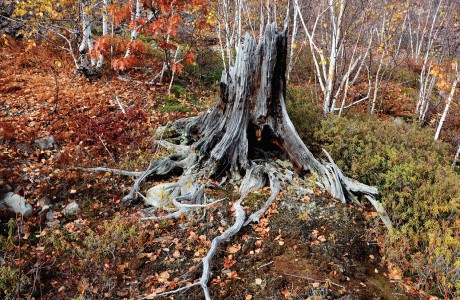
Stump of a large white pine, with stunted “bonsai birch” nearby. About 30 centimeters of soil has been washed away from the roots of the stump.
Not having a central nervous system or a brain is another difference between shrubs and insects. However, all parts of a shrub are connected and information is constantly exchanged among leaves, roots, flowers, and stems. Shrubs have an extensive sense of their immediate environment and react to light, temperature, water, nutrients, touch, soil structure, toxins, microbes, gravity, insect attack, and chemical signs from other plants. The most sophisticated part of shrubs is likely the roots. Roots do not flounder randomly as they grow downward, but search for the best position to take in water, avoid competition, and garner chemicals. In addition, a blueberry seed germinating underground with no light can sense gravity at the tips of its roots and tell the rest of the plant which direction is optimal for its growth—shoots need to grow up and roots to grow down. The advantage of this evolutionary development is that shrubs can survive even after losing 90 percent or more of their biomass.
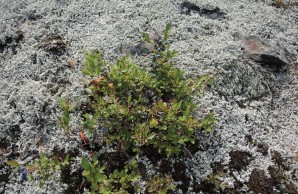
Blueberry shrub established on a mat of acid-resistant lichen growing in once industrial barrens.
In 2015, early spring was also normal and a good crop of flowers appeared, but then came a few days of frost in May. Many of the flowers were damaged. However, flowers that survived the frost in more protected sites, and those that appeared a few days later, were not damaged. These flowers were successfully pollinated by insects and turned into small green berries. Immature berries were developing normally, and then there was a prolonged period of below-average precipitation. The thin layer of soil on Sudbury hills dried out and, as the shrubs experienced drought, they reacted by simultaneously dropping their fruit. The response not only occurred in areas of dry soil, fully exposed to the sun, but it also occurred in shaded areas with adequate moisture. It was as if a message was sent out by the most stressed plants to warn others of a pending drought, and they reacted collectively.
One possible chemical messenger might have been ethylene, which could have been released by plants suffering the most severe effects of the drought. Ethylene is a known regulator of responses to environmental stresses and is produced naturally throughout the life cycle of all plants. It initiates leaf senescence, the aging process that produces autumn foliage, and is produced in copious amounts in ripening fruit. Perhaps ethylene was the signal used by blueberry shrubs in the Sudbury area instructing ramets to drop their fruit. A week later the leaves shriveled and dried, becoming so brittle they crunched beneath my shoes. It was as if a signal emitted and received over the entire region raised the alarm that damaging drought was eminent and water and food resources must be pulled into the rhizomes and roots for use later when conditions improved. The shrubs remained this way until late September when it rained. Once moisture levels returned, the shrubs moved water back into the stems and sprouted new leaves, which produced food and contributed to the overall resources of the clone.
Lowbush blueberry shrub with a crop of berries. This nutritious fruit has likely been harvested in the Sudbury region for over 8,000 years by various human inhabitants.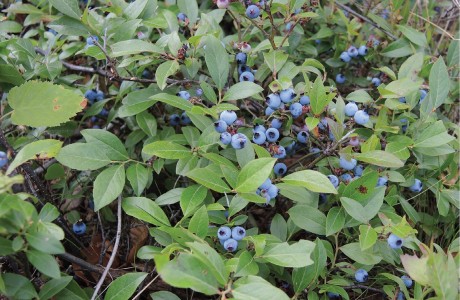
There is the worrisome possibility that the 2015 drought, along with a lower-than-average crop in 2016 was a local indicator of global climatic change. Other local indications of global climatic change were the high temperatures and lack of precipitation (snow) experienced in the fall of 2015. The ability of lowbush blueberry shrubs to thrive in harsh habitats, including smelter-polluted, industrially damaged hillsides, and to overcome frequent periods of adversity such as widespread defoliation, attests to how accomplished they are at adapting. Their contribution to the greening of the Sudbury Basin, however, may have made the area more vulnerable to yet another assault.
In the relatively short time that industrial pollution has been abated, acidity in Sudbury’s glacial lakes has been reduced, making them desirable for residential development, which can produce a new set of stresses on the environment—increased population and sewage, less pervious surface, increased runoff, erosion, and loss of habitat diversity, to name a few.
Ironically, with the rapidly changing environment around the Sudbury Basin due to pollution abatement and restoration activities, lowbush blueberries will likely become less abundant. They are acid– and fire-loving shrubs. Very little sulphur dioxide is now emitted into the atmosphere—the superstack may be decommissioned and torn down—and fires no longer occur on the hills of urban areas. Some blueberries will always persist. It may take longer in the future to fill a pail with Sudbury berries, but there will always be the satisfaction of knowing the shrubs we see today are descendants of clones that are part of an amazing environmental journey.--JDS